 Samuel Navarro Serpa
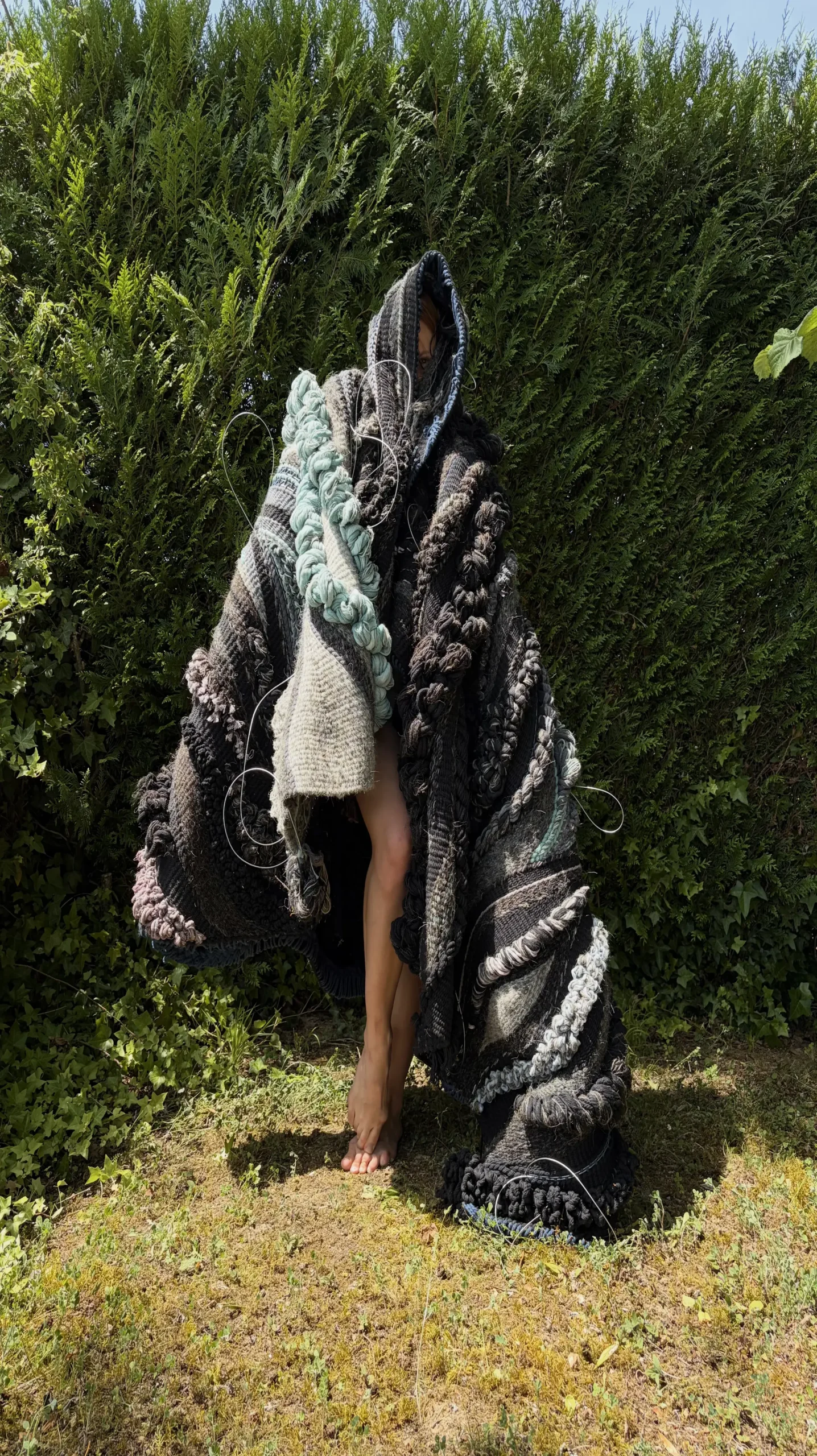
Photo: Courtesy of Yulia Tishchenko
France-based textile artist Yulia Tishchenko brings opposing materials together in works that record emotional states without illustrating them
By Samuel Navarro Serpa
PARIS — From France, Yulia Tishchenko creates sculptural textile objects. Her practice rests on a central idea: materials can carry emotional meaning without representing anything literally. Every work grows out of something the artist seeks to understand about herself, and the final result remains open to whoever encounters it.
Contrast is Yulia Tishchenko’s method
For Yulia Tishchenko, abstraction leaves room for different readings. Dictating what audiences should feel is not her aim: the starting point is intimate, but the finished piece belongs to the experience of whoever views it. Fixed messages are therefore avoided.
Intuition guides the process. Beginning with an emotional state, a color palette and a simple sketch of lines and directions, the artist has no clear image of the outcome. One decision leads to the next, and unexpected events become part of the composition. Making, for her, is the same as thinking, questioning and sometimes accepting what has no name yet. Previously, the magazine published the embroidered silence of Olya Kocherhan.
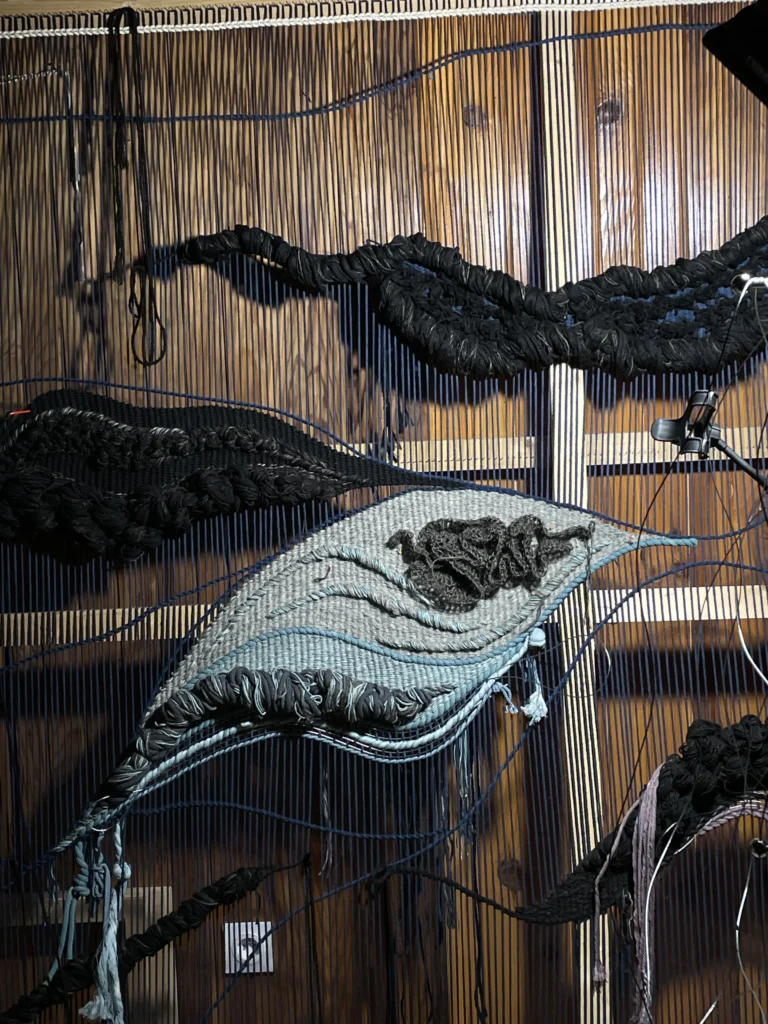
A work in progress on the loom, where each decision leads to the next.Photo: Courtesy of Yulia Tishchenko
Soft threads meet rigid metal, delicate structures share space with heavy forms, and organic movement coexists with geometric tension. Seen by the artist, these pairs are not aesthetic choices: they speak to the complexity of the human condition. Texture and movement express feelings without resorting to representation.
Cotton, wool and galvanized steel wire form the base of the recent works, joined by ceramics in “Reorient.” Hand weaving runs through every piece and is combined with crochet, knitting and mixed techniques, while the material, in the artist’s hands, also guides the final design. Meanwhile in Oslo, Liilian Saksi turns wool from her own flock into sculpture.
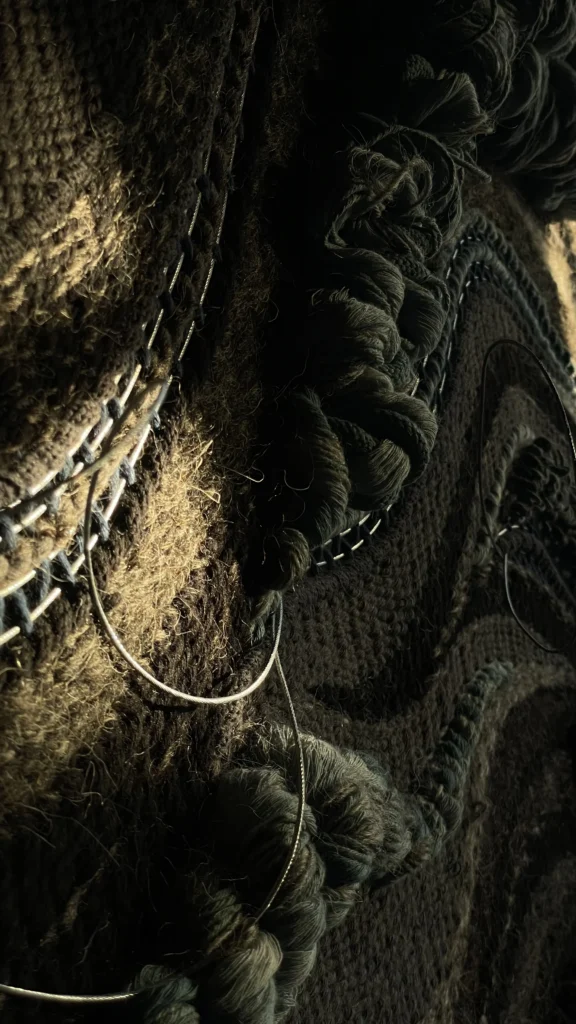
Detail of galvanized steel wire set into wool and cotton.Photo: Courtesy of Yulia Tishchenko
“I don’t consider my works illustrations of emotions. They are physical records of living them, and I hope they leave room for other people to recognize something of themselves,” Yulia Tishchenko says.
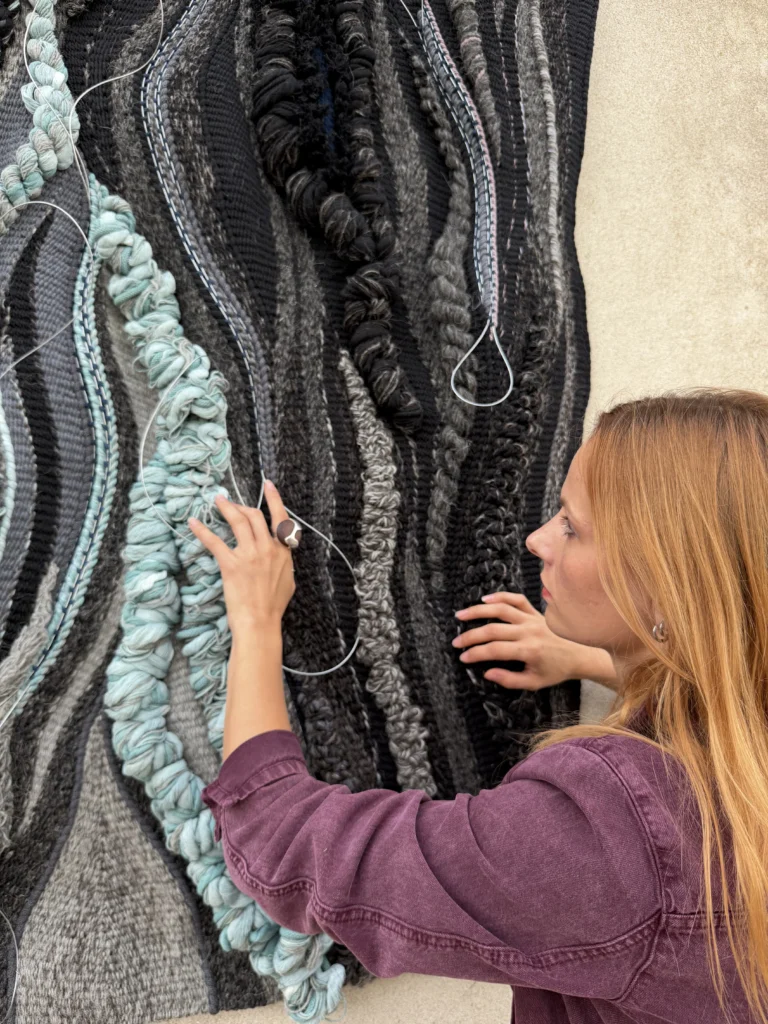
Yulia Tishchenko touching “Fear Less” (2026).Photo: Courtesy of Yulia Tishchenko
“Fear Less” (2026), by Yulia Tishchenko, measures 265 by 165 centimeters and addresses dread without denying it. Its title proposes fearing less, not eliminating it altogether: confronting what is frightening makes progress possible, even when doing so exposes vulnerability.
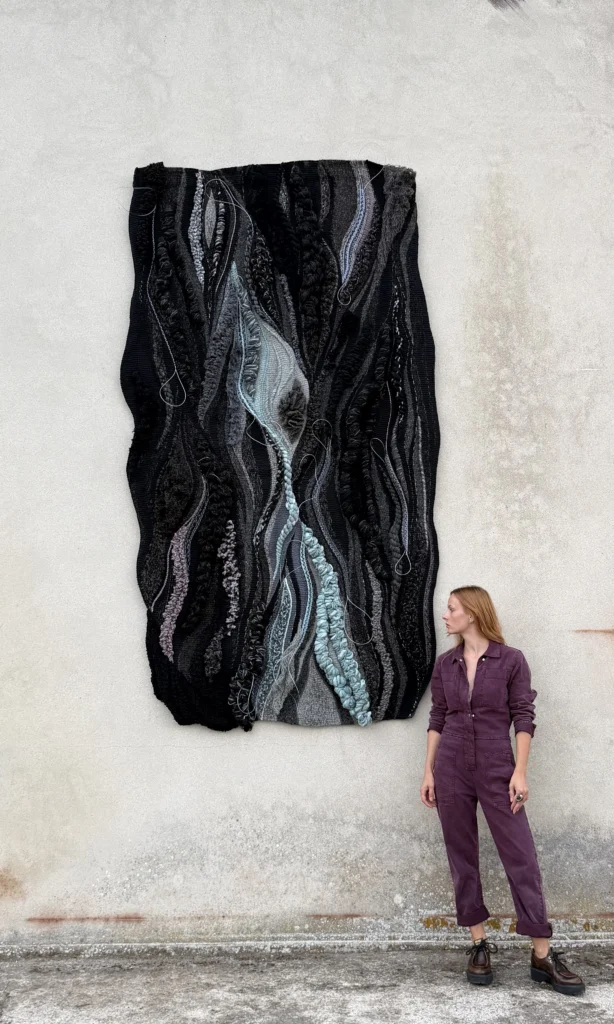
“Fear Less” (2026), 265 by 165 centimeters, beside the artist.Photo: Courtesy of Yulia Tishchenko
Facing fear can reveal what matters, influence decisions and act as a catalyst for transformation. Protection is one of its functions, yet many such worries are illusions that keep people from discovering what lies beyond.
Black, a color that absorbs all others, represents the sum of experiences accumulated over a lifetime, with neither positive nor negative value. Light tones suggest what can emerge from them when courage meets uncertainty. Wires, inserted directly into the textile, correspond to the inner structures each person builds: resilience, skills and self-reliance.
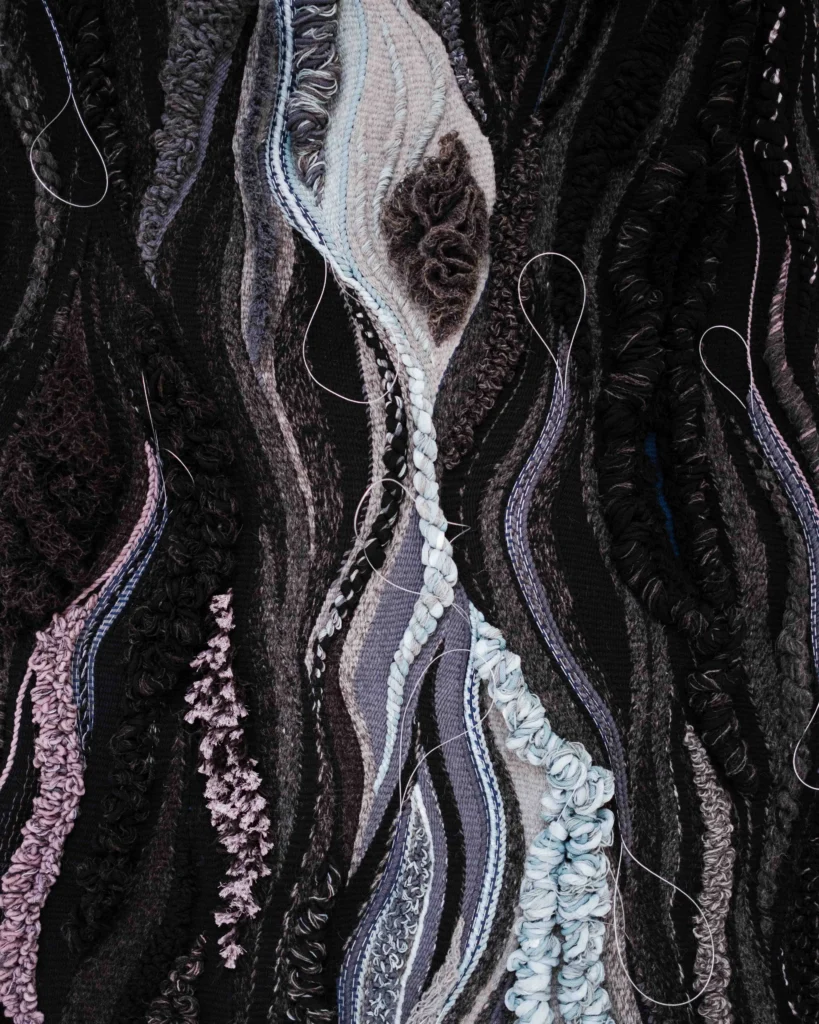
Detail of “Fear Less,” where light tones emerge from a black ground.Photo: Courtesy of Yulia Tishchenko
“Let It Be,” a series by Yulia Tishchenko begun in 2025, comprises four pieces, each measuring 40 by 50 centimeters. Emotional states and internal processes of transition are explored across the works, with distinct rhythm, tension and character throughout. Variations in texture, density and movement give shape to feelings that are hard to put into words.
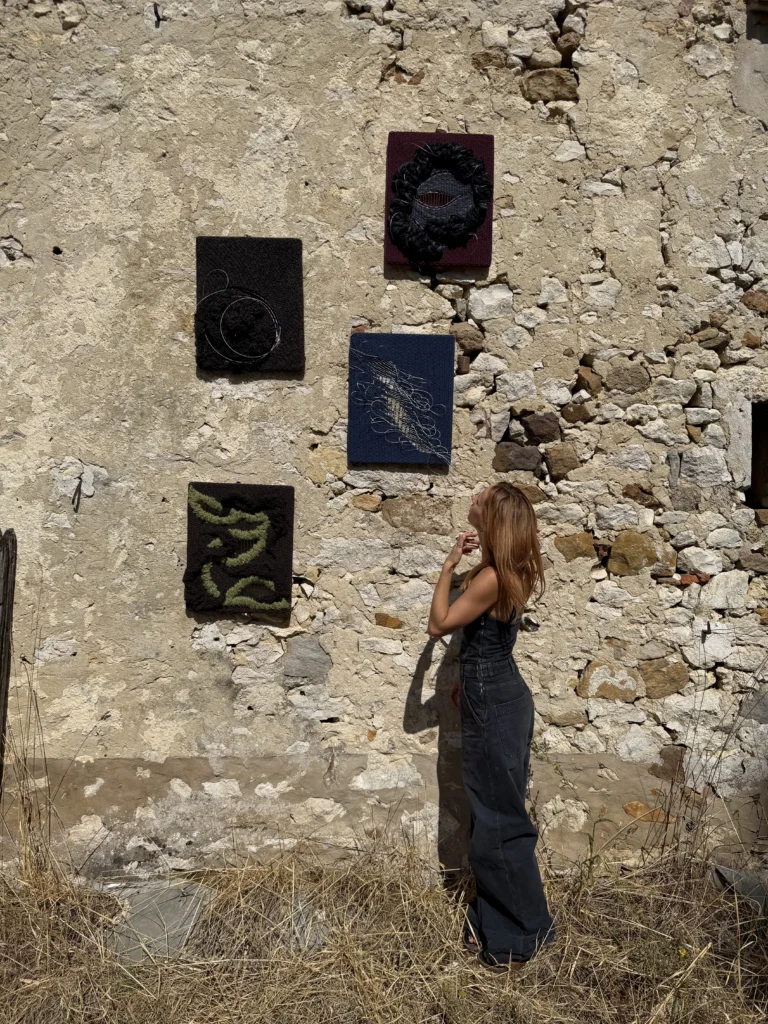
Four pieces from the “Let It Be” series, each 40 by 50 centimeters.Photo: Courtesy of Yulia Tishchenko
Uncertainty, resistance, acceptance, trust and change coexist in the series without being reduced to a single narrative.
“Reorient” (2026), by Yulia Tishchenko, measures 70 by 100 centimeters and addresses the search for a new direction when familiar references lose their meaning. Instead of returning to what seemed stable, it considers accepting inner displacement, recognizing other perspectives and finding new ways forward.
A visual textile artist, Yulia Tishchenko accepts custom commissions for interiors, spaces and private collections. Service is available worldwide. An entry appears in Ateliers d’art de France, with a page on Maison&Objet and a profile on Wescover.